Vetor Interviews: AMANTRA
Born in Maracaibo, Venezuela, and now based in Barcelona, Victoria Garcia, known as AMANTRA, is a DJ and producer carving a path through multiple scenes and geographies. As a classically trained violinist, they bring the discipline of music theory and orchestral practice into the charged atmosphere of the club, composing with an almost scientific precision while leaving space for emotional overflow
Interview by Efe Çilek

Photography by Puxo
Today, when they produce or prepare a set, that early training appears as an almost subconscious architecture. Their sound moves through tension and release, stacking polyrhythmic percussion, metallic textures and ethereal melodies into a narrative which feels both methodical and instinctive. Across their sets, techno, deconstructed club and Latin rhythmic traditions collide at high BPMs, creating a sonic language that refuses fixed borders while remaining tightly structured underneath. That same tension runs through their recent EP releases: 4ng3l and Axioma balance ambient haze and raptor textures, almost angelic melodies, mirroring a state suspended between melancholy and euphoria.
EFE: You began with classical violin training. How does that early discipline still echo through your production or DJ approach today?
AMANTRA: Yes, I feel that discipline is a core outcome of classical training. Classical music is a very strict learning system, and it gave me the methodical approach needed to make music systematically. My early music theory studies also encouraged a more organic workflow. This knowledge influences the structure of my musical pieces. I compose intuitively, but the method and structure from my background naturally guide the process.
E: What’s the emotional and conceptual world behind your latest releases? How was the process of creation?
A: I had been into ambient and elemental Latin influences like reggeton in the moment I started drafting this EP around 2023, when I arrived in Barcelona, I guess it was the nostalgia. Also, some of the lyrics, mostly for the first two tracks, reflect the emotional moment I was going through, where unconditional love and sadness were the main emotions in my life, so I wrote some poems to express what I felt and edited them into vocals for these tracks, where the idea was to use the lyrics as a musical instrument. The textures and glitches throughout the ep reflect the disconnection between the melancholy and euphoria I was feeling. The world behind it is held by an ethereal aura I felt I carried because of my emotional state. I got to project myself as an angel that had fallen on earth.
Indigenous Venezuelan rhythms, the oppressive heat, and sensory overstimulation of Maracaibo, together with the dramatic melancholy of Latin melodies, reappear in their productions. These elements take shape as overcrowded percussions and bittersweet harmonies. Even as they move within queer electronic circuits in Spain and Latin America, their work draws a line between cultural memory and radical club experimentation.

Photography by Puxo
E: Growing up in Maracaibo, what local sounds shaped your musical instincts, and how do they resurface in your work? How has migration shaped your understanding of belonging?
A: I am heavily inspired by indigenous rhythms and gaita—autotonic sounds from Venezuela and Maracaibo that resurface in my productions, even unintentionally. I usually begin with a groove that inherently reflects this rhythmic movement. Maracaibo’s overstimulation—40 degrees year-round and an incinerating sun—influences my tendency toward densely layered, percussive compositions. I fill every silence and space with percussive sounds. The melodic essence of this region relies on endangered indigenous instruments such as sawawa and turrompa, both with acidic tones relatable to synth music. Melodies here are often dramatic and melancholic, a quality I embrace in my productions. My tracks feature heavy percussion combined with sentimental or dramatic melodic and harmonic ideas.
Their love affair with DJing began with sneaking into clubs underage to watch friends play drum’n’bass on vinyl. When someone explained beatmatching to them, the revelation cracked open the very idea of what music-making could be. After years in the “very traditional” logic of the orchestra, realising you could manipulate finished tracks live felt like a jailbreak. “Djing, in my opinion, is a very solid form of art that can get as complicated as you want it to be. For me, it is very much about how crazy you are for it to take it to the next level. People who think DJing is easy don't feel real passion for it or have taken this practice only to the surface level,” they insist. The people who think it’s easy, in their view, are simply not obsessed enough.

Photography by Puxo
The word 'obsession' recurs when they discuss their career and sense of belonging. As a Venezuelan migrant navigating Latinx and European techno circuits, they feel constantly misread — falling between scenes that don't quite know what to do with them. Their work is precisely this intersection: a blend of dark, modern electronics with classic techno clubbing, infused with Latin rhythms. It's a risky stance, but it's also what sets them apart in the current wave of Latin techno. When I ask how they map their sets — whether they plan transitions or let intuition guide them — they answer:
I tend to map a structure before the DJ set, but often adjust it based on the dancefloor. I feel safer arriving with a curated plan that reflects the party and aligns with the expected crowd. Drafting my sets in advance helps me play riskier music; otherwise, I default to familiar, safer options I know will move the crowd. Planning surprises in advance can create magical moments for both me and the audience. Planning ahead makes my set an artistic statement rather than just functional entertainment.
Barcelona became a home for this experiment. In three years, Amantra has played MUTEK, Primavera Sound, and MIRA. LATINEO, a FLINTA collective of queer Latin American migrants, is their base — "a space of friendship where the most authentic side of my artistic approach has been recognised and celebrated," they say, and they mean it warmly. But when asked if there's been a moment of feeling fully aligned with their purpose as AMANTRA, they don't hesitate.
"I honestly don't think I will ever reach that point," they say. Part of it is the obsession with craft — their cup, they say, always feels a little empty. But there's also a structural tension at the heart of their work: "Too Latin for techno lovers, too dark for Latin club music lovers," they say plainly. "Being a crosspath between these two very different worlds is actually my approach." Techno crowds place them outside their canon; Latin club audiences find them too repetitive, too heavy. They fall under neither umbrella comfortably and that friction, rather than discouraging them, has become the directive. In 2026, they are building a convergence space where both energies can finally coexist on their own terms.


Photography by Puxo
E: Collaboration seems key in your world. What does a true creative connection feel like for you?
A: A true creative connection feels like we are bringing something into the world that could only come from our unity. When I create with friends who are creatively compatible with me, it feels natural. We don’t have to be romantically involved to create something new. The traditional hetero cis way society projects love can hurt creativity, as love’s outcome does not always have to be physical touch, sexual, or romantic affirmation.
Beyond their own sets, they see their role in curating and protecting spaces for underrepresented queer and Latin voices in the electronic scene as central to their work. "I am currently working on creating a space that can channel the curatorship I find ideal for a space meant to be the intersection between dark, modern electronics and the classic techno clubbing subculture. I have also been producing music with people I admire a lot and have always been inclined to sharing my knowledge on mixing with others — those are the ways in which I consider I can create a community." Within that framework, LATINEO becomes a home base where collaborations, teaching, and shared DJ practice grow from a shared set of intentions: building a space that reflects both their Venezuelan roots and their presence in Barcelona's queer underground.

Photography by Puxo
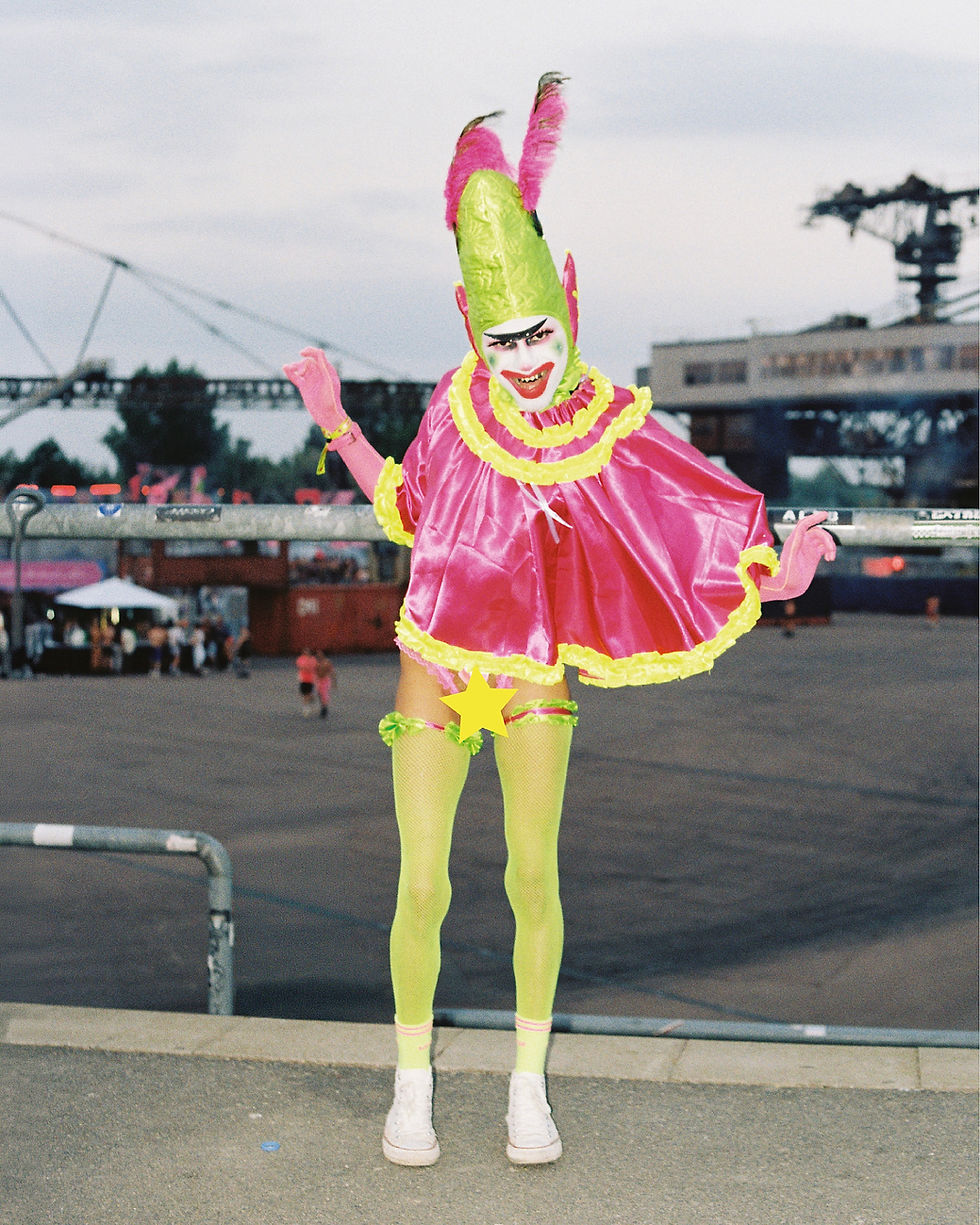
Fashion, for them, is another instrument — though they hadn't always framed it that way. "I always feel more powerful when I dress in certain ways," they say. They never consciously decided that getting dressed was part of the ritual, yet they can't remember a single performance where they didn't pay careful attention to what they were wearing. It happens naturally, the same way their sets do — with intention underneath the intuition. They love clothing, admire designers, and see the way they move through a room as an extension of the same bold, fluid energy they bring to the decks.
When discussing the future, they prefer metaphors to concrete plans. They describe their sound's texture as "harsh metal that's polished around the corners," like abstract liquid metal poured into sand, then carved and melted — heavy yet reflective. This image suits an artist whose work balances friction and shine, roughness and precision, earthly heat and celestial distance. Recently, they have been fascinated by polyrhythms layered beneath angelic melodies, creating sounds that feel like organic matter vibrating at a higher frequency. This idea inspires their new tracks and connects to the angel motif in their recent EPs. When asked what they would tell their younger self, the question feels like a way to close the circle between their past and their ongoing evolution.

Photography by Puxo
E: If you could speak to your younger self, the one learning violin in Maracaibo, what would you tell them about the path ahead?
A: I would express to them that while dedicating yourself to Underground electronic music, you set yourself on a path of freedom and constant questioning at the same time; am I taking the right decision? Is this “stable or feasible as a lifestyle?” At the end, what makes you happy and actually sets you free is the understanding of how deep you can dive into electronic music… It’s an entire world of its own, and the social connections you get to make you make them about that shared passion. Getting to feel one day this sensation of profound and uninterested love for music and for being able to express your musical ideas on a budget, a craft that can get as artisanal as you want and involve a whole bunch of different qualities and techniques, is what makes us all belong to music. Is not a casualty that so much people feels so attracted towards electronic music djing and production, what we address as a huge DJ proliferation is the reflection of the creative liberation that we are going through the tool of the computer these days, this possibility is aligned only with this time frame in history and more people are getting into production or djing thanks to technology. So I would say enjoy the way and get into it as much as you can during your lifetime, as it is one of the purest connections you will experience.

Photography by Puxo
Credits
Photography: Puxo & Noel Cuesta
Styling/Design: Agustin Espinosa
Assistant: Serafin Muguerza
MUAH: R0XAN