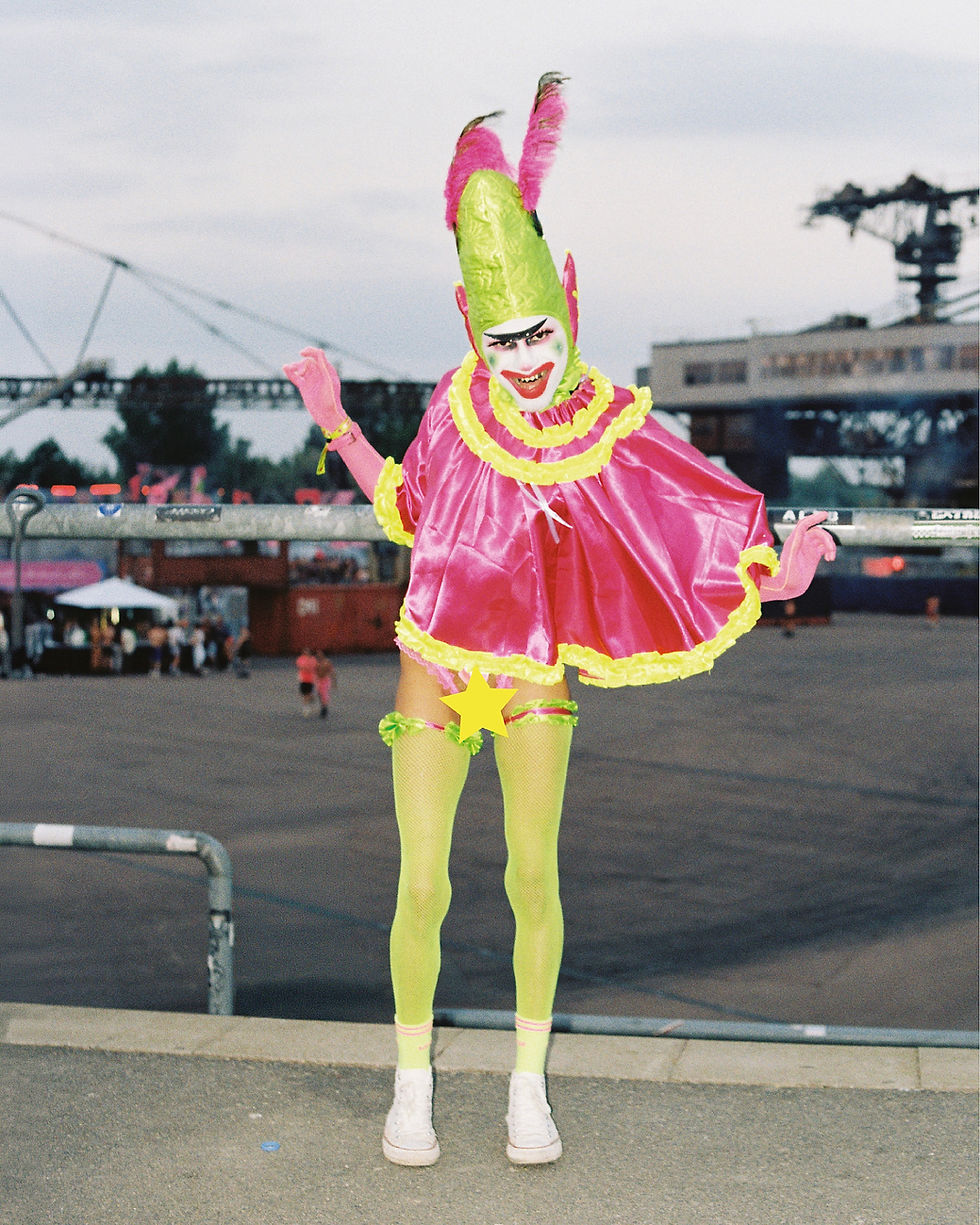
Vetor Interviews: ANHELO
Born in Fuerteventura and now based in Barcelona, Hakito Masao presents ANHELO, a three-chapter audiovisual project with Gabriel Vorbon, reflecting on memory, community, and transformation through his personal journey between both places.
Interview by: Efe Çilek

Photography by: Gabriel Vorbon
Hakito Masao is a DJ and dancer whose debut audiovisual project, ANHELO, emerged after seven months of obsessive creation and a sudden moment of clarity on a tiny terrace. Eyes closed, headphones on, and dancing alone, the project revealed itself almost fully formed. Directed alongside Gabriel Vorbon, ANHELO is structured into three chapters — INERCIA, ABISMO, and FRICCIÓN — each carrying its own emotional charge. Together, they form a complete internal journey from paralysis to surrender to something that feels, finally, like relief. Hakito describes each chapter through what the genres do to the body. Moving through dembow, bubbling, Latin hardcore, Thai trance, and ambient textures, each chapter is occupied by a different emotional state, they mirror a personal journey through momentum, collapse, and eventual release. For Hakito, these genres are emotional tools, each one speaking of something like an out of body experience.
The project is deeply rooted in the landscape where Hakito grew up. Raised in a small town of just a few hundred inhabitants in Fuerteventura, he spent his childhood surrounded by volcanic terrain, black sand beaches, salt-heavy winds, and endless horizons. These memories run throughout ANHELO, forming the core of the project's visual DNA. Turkish-born artist Gabriel helps him bring those memories to life through his own lens. The island becomes a witness to the story that is being told. What makes ANHELO particularly compelling is the way that it transforms longing into a creative force. The Spanish word anhelo describes a deep desire, and a yearning for something absent yet deeply felt. Throughout the project, this yearning becomes less about romantic attachment and more about connection itself: to childhood, to memory, to chosen family, to community, and ultimately to oneself.
At its core, ANHELO is a conversation between the artist that Hakito has become and the child he once was: a kid dancing in his sister's dresses, surfing until sunset, and dreaming of standing beneath stage lights. Yet the project is less concerned with what is missing than with what endures. Friendship, memory, chosen family, queer community, and the possibility of returning to oneself are recurring. As Barcelona's queer underground continues to evolve through new collectives, hybrid sounds, and community-led spaces, ANHELO has found a home among artists building culture through intimacy rather than spectacle. Longing runs through every chapter of ANHELO, though not in the way one might expect. The project looks less toward what is missing and more toward what remains.

Photography by: Gabriel Vorbon
On March 4th, ANHELO was presented for the first time at Sala Taro in Barcelona, a venue that has become a home for queer artists, independent projects, and the communities that gather around them. After seven months of creation, the project finally opened itself to an audience. That night, Hakito danced with his friends, with his mom beside him amidst the high BPMs. What began as a private feeling of longing on a small terrace had become something collective, something tangible. Seeing the transformation in real time and feeling it for myself left me wanting to understand the story behind it and share that with others. For Vetor Magazine, we spoke with Hakito Masao about his inspirations, his childhood in Fuerteventura, and the path that led him to ANHELO.
EFE: First of all, how are you feeling lately, especially after opening your journey to the audience?
HAKITO: I’m feeling beyond relieved and, above all, happy after releasing my baby, ANHELO. In a way, it felt like giving birth, because Gabriel, the creative director of the project, and I spent 7 months bringing it to life.
E: Did you come from DJing, production, or visual arts, or did ANHELO appear as your first hybrid experiment?
H: I come from the world of dance. I did ballet as a teenager, and being on stage has always been a part of me, it’s where I feel at home. However, I never had any formal musical education. ANHELO came to me as a desperate need to heal many wounds.
At the time, Gabriel and I had a beautiful relationship, but after completing the first creative phase of the project… We broke up. I thought the photos would be lost forever. However, after going through a dark period of sadness, we started talking again. One day, he asked if I could go with him to the hospital because they needed someone fluent in Spanish, and of course, I said yes. That same week I was dancing alone on my tiny terrace, with my eyes closed and my headset on, when ANHELO appeared to me like an epiphany. The word itself carries a strong emotional weight, it literally means deep longing, a desire to recover from pain. So I knew he should be the other half of it. I told him about it, and very quickly ANHELO began to take over our hours, then our weeks, and eventually our months. In Christmas, he came with my family and we were editing the video till 2 a.m. every day, it was really fun. I even miss that time; it was splendid. I could never fully express in words how happy I was while working on the project.

Photography by: Gabriel Vorbon
E: Are you referencing anything from your hometown, where did you grow up? How did your childhood shape who you are today, and how does that connect to ANHELO?
H: The creative part of the project was entirely produced near my home in Fuerteventura. I grew up in a small town of just 400 inhabitants, surrounded by low mountains, constant wind, and black sand beaches which is why the photos carry such a breathtaking landscape. I had a very happy childhood with my beloved twin sister, Marina. We were always playing in the valleys, surfing until sunset, or burning our skin under the intense summer sun. I used to dance wearing Marina’s dresses or costumes my parents bought for me. They always knew I was gay and respected it from the very beginning, something I feel deeply grateful for. I came out at a very young age, around 12 or 13, so now, looking back, I truly appreciate that I was able to be myself. Ultimately, ANHELO is dedicated to the child who dreamed of becoming an artist being blinded by the strong lights on a stage.
E: Your new project ANHELO, unfolds across three chapters — Inercia, Abismo, and Fricción. What kind of story or emotional arc are you trying to build across these pieces?
H: I wanted to show with 3 different sets the journey I experienced while creating this project. Each chapter tells its own story through the text that appears in each video, guiding the viewer through different emotional states.
First, INERCIA represents the inner drive an artist needs to create. Through genres like dembow, bubbling or repetitive percussions, I wanted to express that we need nothing more than passion to keep moving forward, which is also the meaning behind the final track of the set, titled Adelante.
Then, ABISMO reflects the space I entered to find the inspiration I needed, emerging from a darker and more introspective place. That's why this chapter contains genres like thai trance, latin hardcore and psytrance.
In contrast, FRICCIÓN acts as a healing force, bringing light when hope feels lost. Through intense dreamlike and ambient sounds, the encounter with the ANHELO is slowly revealed, adding a sense of resolution to the journey. Finally, this last set was originally going to be the only one in the project, which is why it feels like my baby—the piece I cared for the most.
E: How did the collaboration with Gabriel shape the idea of ANHELO from the beginning? How the visuals ended up being such a big part of the narrative? I heard part of it was recorded in your room — how did that intimate setting influence the atmosphere of the film?
H: The collaboration with Gabriel turned the project into something deeply meaningful and emotional for both of us. He has an exceptional eye for deciding whether something is visually appealing or not. While this may sound subjective to many, he has a strong instinct for understanding what the audience wants to see. From the beginning, we aimed to create something unique, fresh, and simple. At times, we even held meetings at midnight to decide small details like whether a table should be made of metal, wood, or plastic. Ultimately, we agreed that everything needed to be visually engaging, especially considering that people often watch TV while also looking at their phones. For this reason, we chose to use two cameras, helping to stimulate the audience and better capture their attention. We developed the entire project in Gabriel’s living room, transforming it into our own ephemeral and cozy studio. As a result, the project carries a strong sense of intimacy, something we likely could not have achieved if we had rented a space with unfamiliar people constantly moving around.

Photography by: Gabriel Vorbon
E: Since part of ANHELO was shot in the Canary Islands, was there one unforgettable moment from that shoot that stayed with you?
H: Yes, haha. I have a very cute tiny dog called Kora (well, she’s a bit overweight, but still tiny… kind of like a little meatball). I miss her every day. She has separation anxiety, but she doesn’t want to go to therapy, and we respect that. While we were shooting, we took her out for a walk without a leash, as we usually do. She kept wanting to stay close to me, so we decided she should be part of the project as well. There’s a very sweet moment where she tries to grab my hand with her paw and her long, slightly painful nails. Of course, Gabriel’s camera was there to capture that intimate scene. Nowadays, that photo is my phone wallpaper.
E: Your sets move through dembow, bubbling, latin hardcore, and thai trance — genres with very strong rhythmic identities. How do you approach blending these sounds into something that still feels cohesive?
H: I usually begin my work by making a big mess and then finding my way out. I believe variety is essential to building something meaningful. I really respect DJs who are focused in one genre and they master it, but it's not my cup of tea. By blending very different genres, I’m able to explore a wide range of elements, from percussion to hypnotic vocals. At times, I would take just 10 seconds from a track and experiment with it, letting it evolve into something new.
At the launch event, I was honestly a bit nervous. I wasn’t sure how people would respond to the intensity, especially given the early time (20:00). However, I was surprised to see how much people danced and connected with it, which made me really happy.

Photography by: Gabriel Vorbon
E: In your posts, you play with the idea of desire/anhelo as a small moment. What kind of desire are you documenting here: romantic, sexual, spiritual, or social?
H: I'm mostly documenting a spiritual desire, even if it may not appear that way at first. More specifically, it’s the desire to feel complete by connecting with the souls of my audience and, hopefully, elevating their dopamine levels, even if just for a moment. At the same time, I believe there is a sense of mystery within even the most banal things. Therefore, my intention is to reveal it or at least to create a crack in the mundaneness and offer a glimpse of the miraculous.
E: Barcelona’s underground scene has been shifting a lot in recent years. Where do you feel your project sits within that ecosystem?
H: Luckily, Barcelona’s underground scene has evolved in recent years. Nowadays, there are many safe spaces for queer people; however, I still believe more progress is needed. Managers, venues, and bookers should take greater responsibility by giving real visibility to queer artists and hiring them without resorting to pink-washing. At the same time, I feel that my project and artistic approach could resonate with several collectives in the city, such as Club Expansivo, Latineo, or Me Siento Extraña. In my opinion, they are doing an incredible job by paying close attention to every detail, from lighting and sound quality to creating safer environments through dedicated awareness teams. I look up to them.
E: I saw in your event that you were dancing so freely with your mom and friends. How important is it for you to feel that support from your circle?
H: When I first told the people around me about the project, they were a bit shocked because of Gabriel and my recent breakup. At first, they couldn’t understand how ANHELO could bring something positive without us even intending it. However, over time, they began to see how important it was for both of us. At the same time, they supported me in very honest ways, telling me if a track wasn’t working or if the styling felt off or too much. Thanks to my dear friend Anto, the styling became truly striking. Thanks to Leyre and Kika, the text avoided feeling forced or unnatural. And thanks to my sister, I was always able to see the positive side of everything. My mom Susana, on the other hand, supported me from the very beginning. When I told her about the launch party, she immediately bought a plane ticket and came to dance with me at 160 BPM, I will never forget that event.
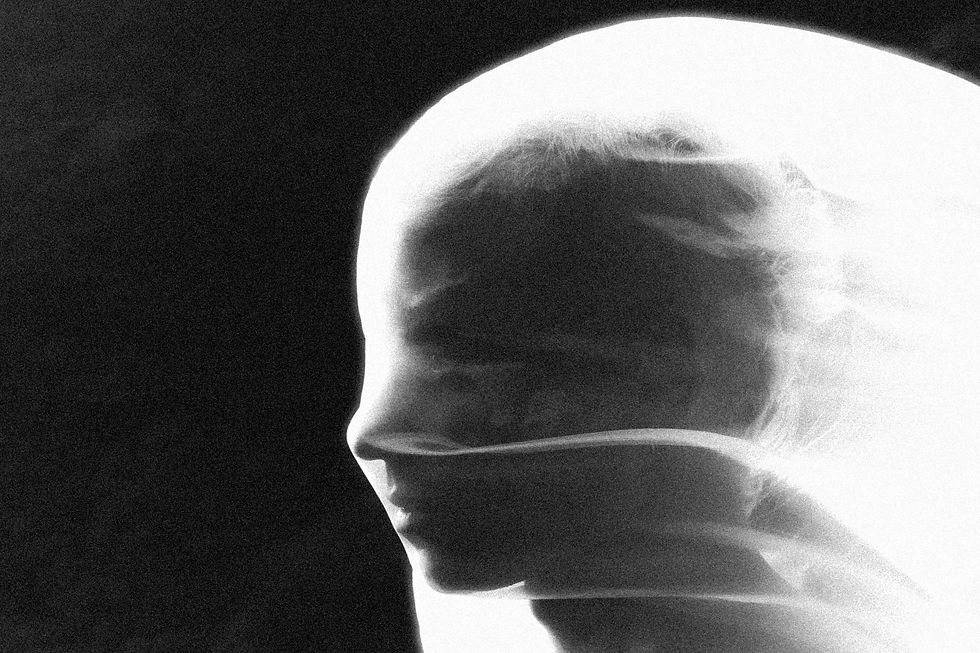
Photography by: Gabriel Vorbon
E: Are there any films, artists, songs, or collectives that have influenced your path and helped shape ANHELO? What is your inspirations?
H: My main inspiration is Perla Zuñiga (aka Joven de la Perla), an artist, poet, and magnificent a DJ who sadly passed away two years ago. I saw one of her sets at Sonar Festival in 2023, and it completely changed the way I understand music. It felt like a flash of light breaking through a violent storm. I had never truly been a fan of anyone until I discovered her. In that moment, I knew I wanted to become a DJ. At the same time, artists like Slim Soledad, Mina Galán or Jass have also played an important role in shaping my approach especially in the way I transition between tracks and how I present myself on camera.
E: Do you have any items that you think it gives you luck?
H: Yeah, I do haha. I have a music box that plays the melody “Somewhere Over the Rainbow” from The Wizard of Oz. It’s a cute film that reminds us that what we seek is often already within us, and that there’s no place like home. Whenever I'm nervous or doubtful I play it, but it's a secret!

Photography by: Gabriel Vorbon
E:What’s next for ANHELO, and how do you imagine the project growing from here?
H: I dream that ANHELO becomes a party or a collective one day, or perhaps I’ll leave it as it is. Some things are meant to remain in the past, making space for new ones to emerge.
E: What's your advice to creatives who feel like they don't fit into any existing scene?
H: My advice is that they should create their own scene, their own rules, and if that’s not possible, that’s also okay. You don’t have to fit anywhere; you are perfect just the way you are. But baby, let me tell you one thing! Go out there in your cutest little outfit and find peace among the souls who appreciate your laughter, your wisdom, your kindness, and most importantly, your love.
Interview by: Efe Çilek
VETOR MAGAZINE