Vetor Interviews: BENGALA
- Oct 14, 2025
- 7 min read
In this interview, BENGALA opens up about reclaiming their name, reconciling with their roots, and transforming identity into sound. The artist, shaped in Barcelona's nightlife, reflect on queerness as home and resistance, and on how the chaos of Indian wedding music shaped their club universe.
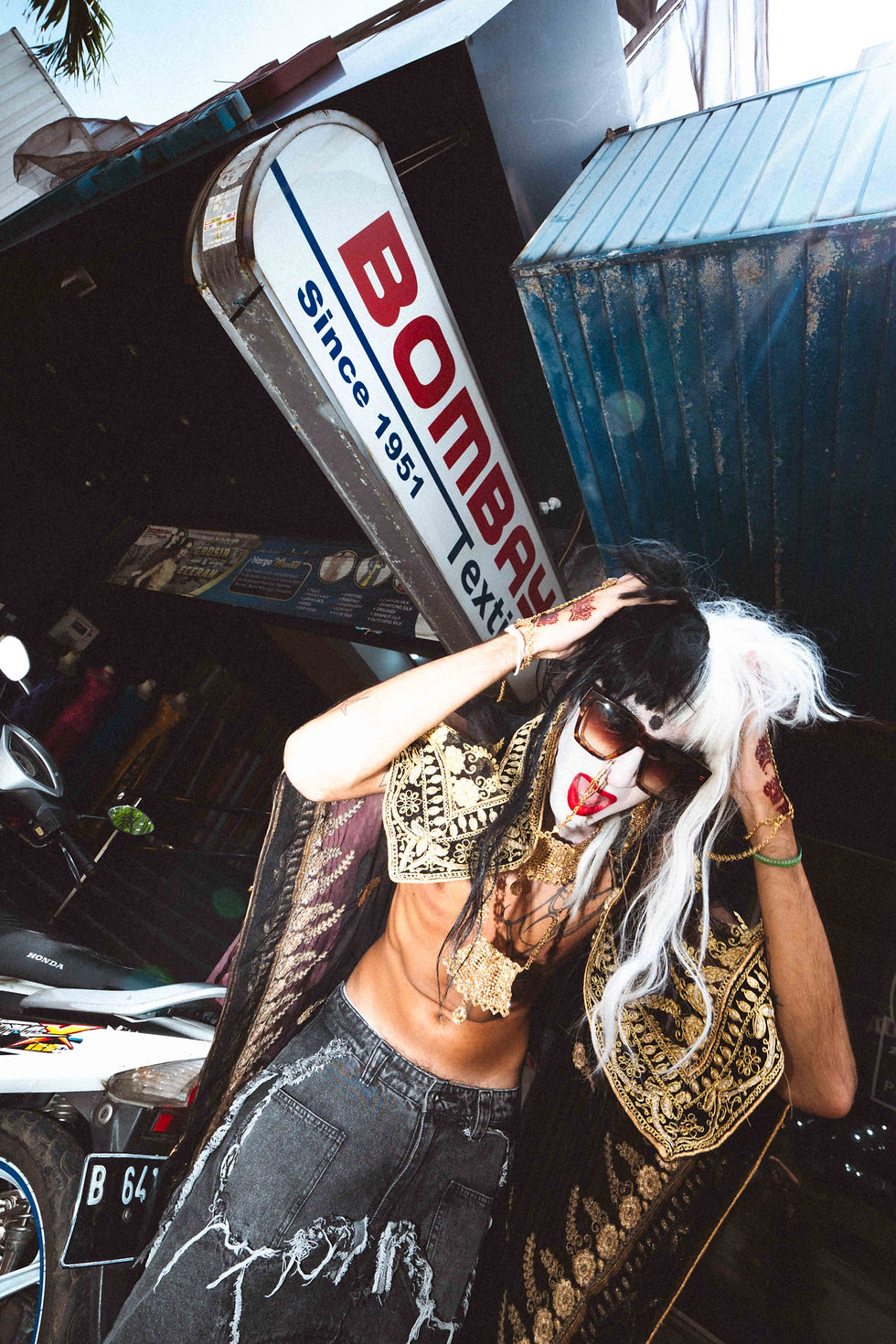
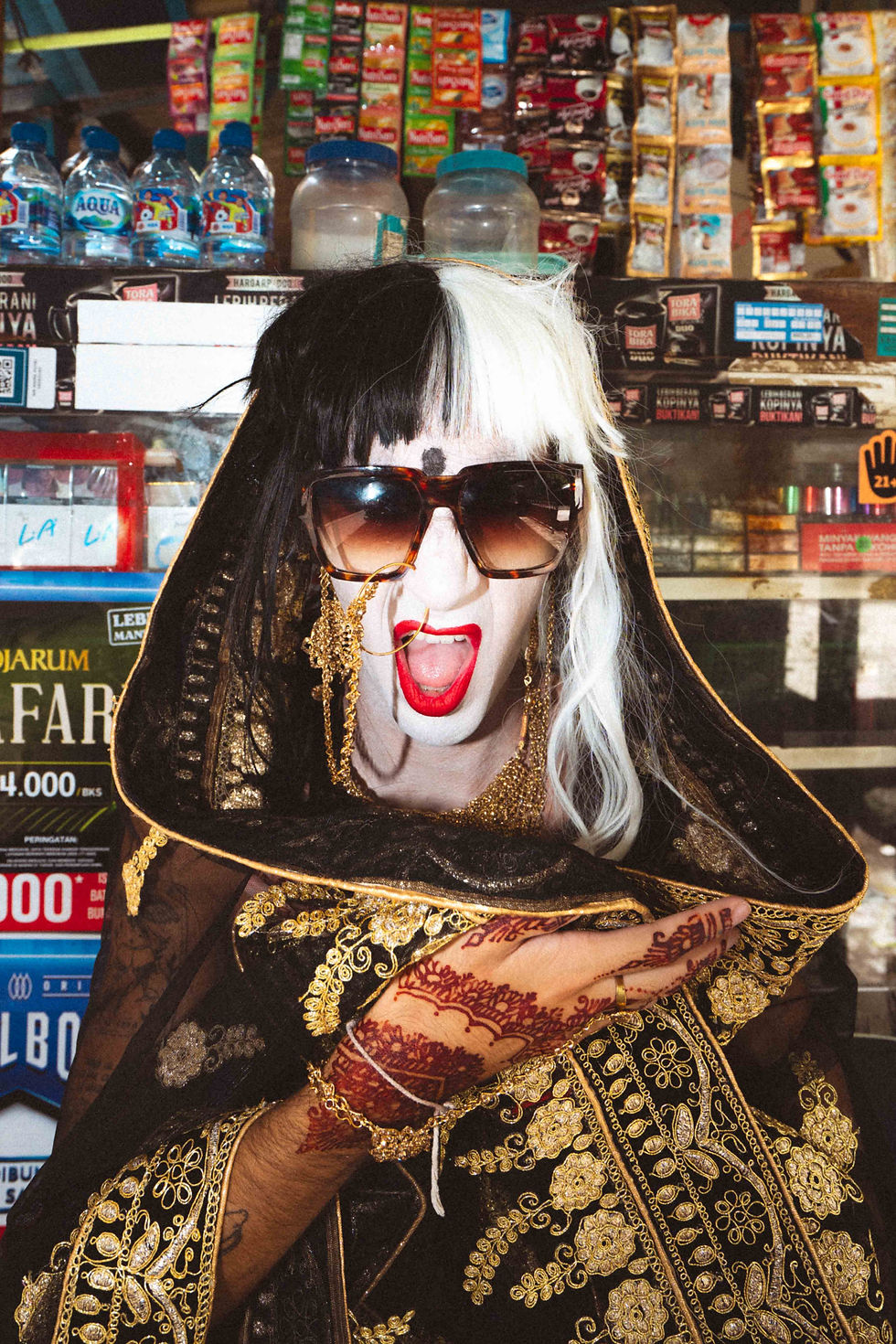
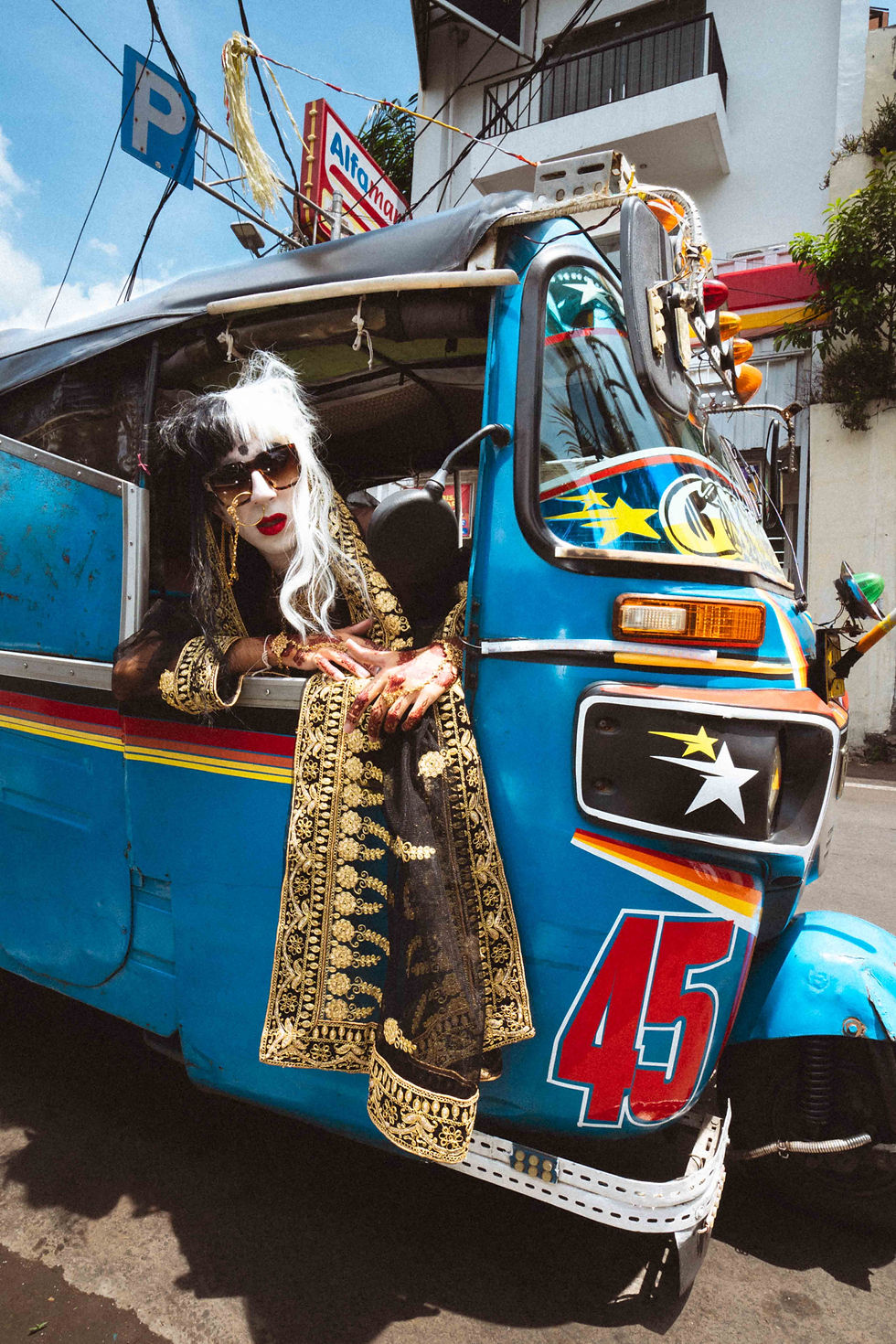
Through Chica Bombay, BENGALA embodies the beauty of being in between cultures and genders. Shot in Jakarta with Gina Botella, the images capture that celebration and defiance intertwined. Interviewed by Nickolas Chong

Photography by Gina Botella
Vetor Magazine: What inspired your fusion of Indian Dance Music with electronic textures?
BENGALA: Music plays a central role in the countless subcultures across India. I have many cousins in Bombay, all older than me. Since I was a child, I traveled frequently to India whenever one of them got married. Weddings in India are incredibly important and transcendent events. These celebrations have been the largest, most chaotic, and most unforgettable parties of my life. Music has always been a central element in these events, from religious celebration music to Bollywood and Indian dance music. The euphoria and joy surrounding these moments inspired me to incorporate references, instruments, sample melodies, and rhythmic patterns drawn from my Hindu roots into my sets.

Photography by Gina Botella
VM: What does queerness and a queer community mean to you?
B.: It has been my salvation, a hope to live a happy life. I don’t think I could have lived happily without being surrounded by women and queer people. For me, it’s home—it’s support, community, and resistance against a capitalist and cis-heteropatriarchal system that has no space for us in its agenda.
Photography by Gina Botella
VM: Growing up with roots in India and Indonesia, how has your heritage shaped your queerness and sense of belonging?
B.: It’s been a journey. Growing up in a European country but “not being European enough” makes you feel marginalized. As a child, I hated everything that made me different in Spain—my name, my body hair, my slightly darker skin. I hated that people knew my family was Indian; it made me feel on the outside. I hated having to repeat my name because it wasn’t understood—it reinforced my sense of not belonging.
As a teenager, I also thought my family in India and Indonesia would never understand who I am. You grow up believing that European culture is “the best,” “progressive,” and “modern,” so how could my family understand that I was queer? I thought being Indian was incompatible with being queer. White queer norms didn’t help me feel represented either.
Luckily, after adolescence, I began valuing my ancestry. I explored queer histories in Asian countries, and my trips to Asia became adventures discovering how queer and non-normative identities presented themselves there. Understanding my heritage as something intrinsic to me, not filtered through my family’s ideals, brought reconciliation. I found a clear connection between being mixed-race and being queer. Queerness, I realized, is about the incomprehensible, the monstrous—what I had always been as a small mixed-race “travesti” child in Spain.
And I quote Sara Ahmed: “I am not sure that being mixed race is what makes me queer, though other mixed race queers have made this connection and it is one that could be explored. Instead, I would say that the experience of having a mixed genealogy is a rather queer way of beginning, insofar as it provides a diferent ‘‘angle’’ on how whiteness itself gets reproduced.

Photography by Gina Botella
VM: Why are you changing your stage name from SÁGAR to BENGALA?
B.: Ságar is my legal name, chosen by my grandmother. In Hindi, it means “ocean.” For years, I hated my name because it made me feel different and revealed my ancestry. It is a beautiful name, and now I love it. Choosing it as my stage name was a way to reclaim something I had long rejected.
However, I have decided to change my artistic name to BENGALA. Beyond music and DJing, I do many things and wanted to separate my professional persona from my musical project. The name BENGALA captures my work symbolically: first, it evokes “bengalas” (fireworks): fire, intensity— perfectly describing the energy of my sets. Second, it references the Bengal tiger, my favorite animal, native to India. In the future, you will see how it reflects the direction of my musical project.

Photography by Gina Botella
VM: What inspires you to become an artist, and what goals do you hope to achieve?
B.: Music and art are my ways of channeling emotions. I am a very emotional person, and creating music or visual universes around my music helps me process what I feel. My curiosity and desire to always learn have taken me far: composing, playing instruments, producing, DJing... When I DJ, my inspiration comes from creating a good time for my friends, who always come to see me and dance from the first track to the last. DJing is like sharing the songs I love with friends, teaching them about my musical tastes, and even in festive environments, there is something intimate about it.
My only goal as an artist is that my happiness never depends on what I produce. I never want to be a slave to an industry that demands excessive output. I want art to remain a way to channel myself, have fun, and enjoy the process. Fortunately, besides making music, I have many other passions and pursuits—I am also a businesswoman.

Photography by Gina Botella
VM: As a DJ, producer, and singer, how do you connect with very different crowds—from Barcelona’s nightlife to Southeast Asia’s underground?
B.: I feel my work is eclectic enough that, even though Barcelona and Jakarta are very different, audiences in both places can connect with different aspects of it. Additionally, what they don’t immediately relate to feels “exotic,” which generates interest and adds value to my project. In Barcelona, I am the Indian girl; in India, I am the Spanish girl. While I once resented never feeling “enough” anywhere, I now see it as a differentiating factor that enriches my artistic approach. In every place, I can highlight different aspects of my project, and as an artist, that is very fun. Being a travesti allows you to play with identity freely.

Photography by Gina Botella
VM: How have you experienced Barcelona’s nightlife, and in what ways do you feel it connects to the sense of community fostered by different collectives?
B.: Barcelona is my favorite city. It has a vibrant cultural scene and talented people. The city is eclectic, diverse, and forward-thinking, which reflects in its nightlife—full of cultural spaces that support the underground.
Growing up here educated me culturally. Clubs helped shape my personality and identity, exposed me to musical projects that influenced my style, and allowed me to meet incredible people. I feel that in Barcelona, otherness and queerness are prominent in the scene (though still not enough), encouraging creativity, entrepreneurship, and the feeling that “we do it better.”
VM: Linking back to your heritage, how does your work create an impact in our queer space in South East Asia.
B.: My discovery of the queer scene in Southeast Asia has only just begun, and I approach it with curiosity and humility. Even though my heritage is Hindu, I did not grow up in India, so I am conscious of not projecting European frameworks or imposing outside narratives onto Asian queer spaces.
What I have learned so far is that queerness in Southeast Asia carries meanings, codes, and histories very different from those in Europe. My work creates impact not by prescribing, but by listening, learning, and finding ways to support visibility and resilience that are already present in these communities. I believe that honoring local expressions of queerness, while connecting them to broader conversations, allows me to contribute meaningfully without erasing what makes them unique.
Photography by Gina Botella
VM: Your collaboration with Gina Botella in Jakarta created layered, striking images. What conversations shaped that project, and what/who inspired your style in the photoshoot?
B.: Gina and I, both from Barcelona, crossed paths while living in Indonesia. She’s an incredible photographer with a strong background in street photography, and we were eager to collaborate. At the time, I was beginning to integrate my Hindu heritage into my artistic projects. Sharing these ideas with Gina, we created the vision of an alter ego—‘Chica Bombay,’ a travesti figure embodying the duality of my Indian heritage and queer experience.
The character was inspired by the hijras of India, a community often seen as a ‘third gender’— spiritual and resilient, yet deeply marginalized. When I started to imagine the ‘Chica Bombay,’ I realized I wasn’t only referencing them, but also reflecting something within myself. Like the hijras, she exists in between—between celebration and rejection, visibility and invisibility, heritage and queerness. It’s also a reminder that the rigid idea of the gender binary was largely imposed through colonization; many cultures and religions had long recognized non-binary identities as part of their spiritual and social fabric. Creating these images became a way to connect with that duality in a very personal way.
Jakarta, a chaotic metropolis, became the perfect stage for this encounter between cultures, identities, and contradictions. We did the shooting during Ramadan, and at first, we were nervous about being so exposed in the streets. But the response was incredible—far beyond what we could have imagined. People approached us to take photos, to talk to us, to ask questions. There was not a single sign of disrespect. The ‘Chica Bombay’ stood in the middle of the city that observes and judges—a figure that belongs and does not belong, suspended between the vibrant queer life of big cities and the shadows of cultural rejection.
Photography by Gina Botella
VM: What’s your next step—what should we expect from you in the near future?
B.: I am working on my first album—the one I have always wanted to make. I feel it brings together all parts of me. It’s a club album filled with references to my Hindu heritage. We have collaborated with many Indian musicians who have contributed immensely to the project. It tells the story of the Chica Bombay, and that’s all I can share for now.
VM: Finally, what do you hope a queer kid in Jakarta, Manila, or Bangkok feels the first time they encounter your work?
B.: That we are cool too, even cooler—no shade. That there is no single way to be “queer.” In South Asia, the idea that European and white culture is “better” or “more beautiful” is deeply ingrained, and this also influences queer identity and art. I hope that when a queer kid sees my work, they feel inspired to be their own version of the Chica Bombay, and realize that we can also be a reference ourselves—we don’t have to follow any white canon. We’ve been pushed to follow that line to suppress our creativity and power, but our work shows that we can define our own paths.

Photography by Gina Botella


