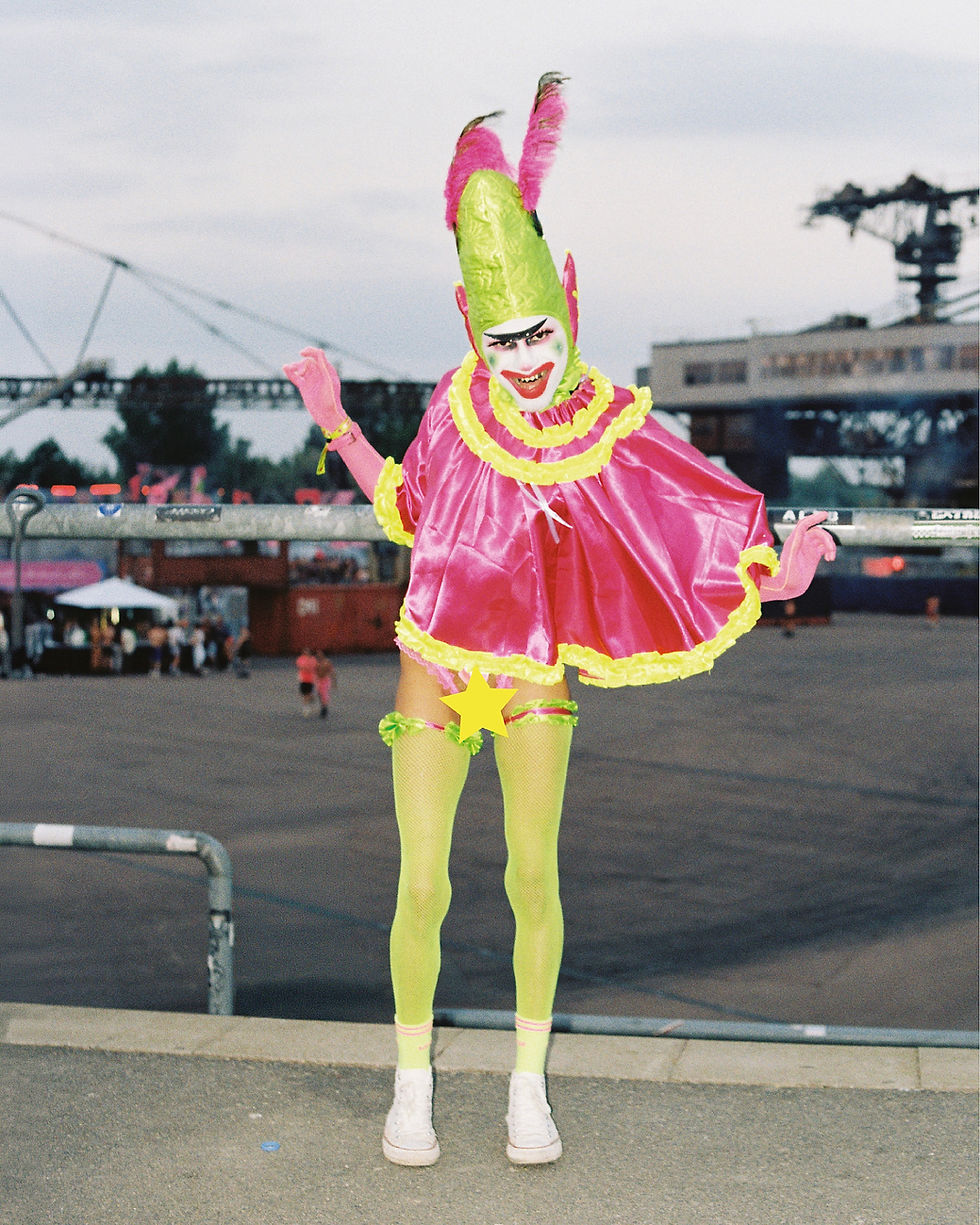
Vetor Interviews: RICO RICA & Chicloso
With em0boy, RICO RICA and Chicloso shape a collaboration that expands the boundaries of contemporary alternative pop — building a shared language of emo nostalgia, Latin club textures, and queer desire. Moving between fragility and intensity, the track inhabits heartbreak rather than explaining it, letting it mutate into something sensual, excessive, and impossible to let go of.
Interview by: Efe Çilek

Photography by: Abraham Mora
RICO RICA and Chicloso released their collaborative track em0boy a few weeks ago, and it moves like a love spell caught between memory and mutation. Out through Barcelona label AUX1, the track began as a demo and expanded into its own universe — folding together early-2000s emo nostalgia, Latin club instincts, queer desire, and a darkly romantic emotional register that refuses to stay in one lane. The track is described as moving from a fragile, tremulous opening into something vampiric, sensual, and slightly sadistic, where pleasure and pain blur until they are almost indistinguishable. Rather than presenting love as soft or redeeming, em0boy frames it as a force that can consume, distort, and wound. There is devotion here, but it is devotion under pressure; closeness, but closeness that feels almost fatal. The result is a song that doesn’t simply narrate heartbreak — it inhabits it, exaggerates it, and lets it mutate into a fever dream.
The song sits at the intersection of two distinct but overlapping worlds. Chicloso is the project of Fernando Díaz de la Vega Sánchez, a singer and producer from Mexico City whose musical journey began at nine as a vocalist moving through happy punk, emo, and nu-metal before turning toward the rhythmic structures of sound system culture. RICO RICA is a Colombian-Canadian DJ, singer, and songwriter born in Barranquilla, whose crossover imagination draws from picó culture, guaracha, reggaetón, and dembow, all coexisting and flowing freely into one another. Together they build something that feels both intimate and excessive. Two artists already speaking the same emotional language, meeting somewhere neither of them had been before.

Photography by: Abraham Mora
With «em0boy», RICO RICA and Chicloso consolidate a collaboration that aims to expand the boundaries of contemporary alternative pop, offering a piece that transforms vulnerability and romantic obsession into a visceral soundscape. What makes em0boy compelling is that it doesn’t try to clean up the mess of desire. Instead, it leans into it — the delusion, the mourning, the longing, the darkness, the pleasure of holding on too long. The track seems to have been made inside the tension between holding on and letting go, between the desire to preserve a relationship and the clarity that it is already ending. RICO RICA describes it as something pulled from the “conflicting feeling of being in love while also knowing that the dynamic is hurting both of us,” a song written from the last stage of moving on, when the relationship has become more like a wound you continue to revisit than something you still believe in. In that sense, em0boy becomes a purge as much as a song: a place where delusion and desire are allowed to coexist. The result is a track that feels at once local and global, nostalgic and hypermodern, deeply personal and strangely mythic. It is a song about love, but not in any simple sense; it is about what love becomes when it turns into atmosphere.

Photography by: Abraham Mora
VETOR: First of all, how do you feel after the release of your new collaboration?
Rico Rica: We’re happy it’s finally out - we waited a long time for this release, and we feel good that it’s out in the world now. We worked on it for a whole year.
Chichloso: I feel like releases always feel long overdue, lol.
V: What does em0boy mean to you, and why was it the right title for this release?
The demo that Chicloso originally showed me was called “emo,” and it inspired the universe and lyrics for em0boy. I also dated a couple of emoboys in the past, and in a way I also consider I’m a bit of an emoboy myself.
V: The press describes a “feverish dream” blurring pleasure and pain — does this reflect personal stories of unattainable love?
R: This song definitely draws from past experiences in relationships, dealing with the conflicting feeling of being in love while also knowing that the dynamic is hurting both of us. We also knew it was about to come to an end, but we were stretching it out, mourning the relationship while still being in it.
It was a moment of delusion, of not wanting to let go — wishing death would do us part. I was in the last stages of moving on when I wrote em0boy, so for me it was a bit of a cleanse or purge.

Photography by: Abraham Mora
V: The press text describes the romance in em0boy as vampiric, sensual but slightly sadistic, devotional but dangerous. Do you think queer desire gets to be monstrous in pop music, or does it usually get softened?
R: There’s definitely been some artists exploring a monstrous desire in pop music, like Lady Gaga in The Fame Monster. More recently, Arca, Yajaira la Beyaca and Metrika have been making bangers with queer monstrous desire at their core — Metrika, in my opinion, is the mother of bisexual obscenity. I think we’re often demonized for expressing these dark desires but there’s a growing audience for these darker more experimental artists within pop, where the scandalous can be embraced and not diluted.
That answer places em0boy inside a wider lineage of queer pop that doesn’t ask to be softened. It also helps explain the emotional architecture of the song: rather than sanding down its sharper edges, the collaboration leans into them. The press release’s language around vampiric romance, danger, and sacrifice suddenly feels less like metaphor and more like method. This is music that wants to let the darker interior of desire remain visible, even attractive, even danceable.

Photography by: Abraham Mora
V: This collaboration brings together Barranquilla, Montréal, and Mexico City. How did that geography shape the sound?
C: We didn’t really make this song thinking of where we come from, we ultimately feel that the sounds that shaped the aesthetics of the song are already kind of embedded in our subconscious, and that’s what made us make the decisions we made.
R: In a way there’s definitely a bit of Colombial and Canada that transpired while I was writing the lyrics, Montreal’s winter nights contrasting with Barranquilla’s drenching heat that makes you sweat buckets– that duality marks that contrast, and they’re both uncomfortable extremes that amplify and exaggerate the feelings of loneliness / passion.
V: What does this collaboration open up for you both, separately? Is em0boy a beginning of something or a snapshot of a specific moment?
C: I think em0boy is not necessarily a snapshot of what’s coming in my music production-wise, but it was definitely the beginning of the vocal exploration I’m on.
R:For me, it’s a continuation of deeper, more emotional music that marks a difference from everything else I’ve put out before. Anoche also lives in that realm, in a similar imaginary of hurtful love. Maybe Anoche would be the wet dream and em0boy the wet nightmare.

Photography by: Abraham Mora
V: Do you see em0boy expanding alternative pop boundaries for queer club scenes?
Queer pop is always the most avant-garde. Queer artists are always pushing the boundaries and bringing fresh sounds into the scene, and we’re definitely trying to honour and keep that mentality of not trying to fit into a box or staying within one genre. In a way, we’re calling for people to maybe connect with those less pretty feelings inside them and to be able to dance it out at the club, embracing that darkness without shame.
V: The single feels like healing open wounds. How do you want fans to experience that catharsis?
R: I think everyone can connect in some way or another with the song. For me, I hope they can maybe remember a hurtful experience and see it with new eyes. It’s an invitation to romanticise, to let themselves be the evil one, to cry or laugh about it.
C: I always like to experience songs that speak to me in my home stereo with the volume dial really high up while nobody’s around. Hopefully someone feels the need to do the same with em0boy.
V: With this new AUX1 release today, what’s next for you and the label?
We’re really excited about the remixes. We invited people from different countries to reinterpret it, and there’s also a bonus track which is the original demo that Chicloso first showed me. I love that we can let people experience how it evolved and changed through our collaboration. It’s going to be a nice range for DJs to have fun with it. We’re planning on having a live show and release party for the remixes in CDMX that we’ll announce soon, and maybe some merch, who knows.

Photography by: Abraham Mora
V: If em0boy were a physical space, what room or ritual would it be?
C: A cave or a dungeon, probably — somewhere really dark.
R: BDSM dungeon meets Dracula’s coffin. And the ritual would probably be an “amarre,” like a twisted love-binding spell, something you can’t get freed from.
V: And if someone listens to your music for the first time, what emotion do you want to leave behind?
That love is real.
What Em0boy leaves behind is not resolution but recognition. A portrait of desire that is messy, dark, funny, wounded, and completely alive. RICO RICA and Chicloso don't clean up the emotional mess they make it sing, sweat, and glow. And at the centre of all that darkness, distortion, and ritual, the answer is still the simplest one: that love is real.
Credits:
Photos by Abraham Mora
HMU by Jamaica Imán & Esfera Permanente
Styling by Rico Rica